Self-custody and crypto swaps: follow control before, during and after the trade
Owning your keys changes custody, but a swap can introduce approvals, contracts or temporary provider control. Trace the whole route.
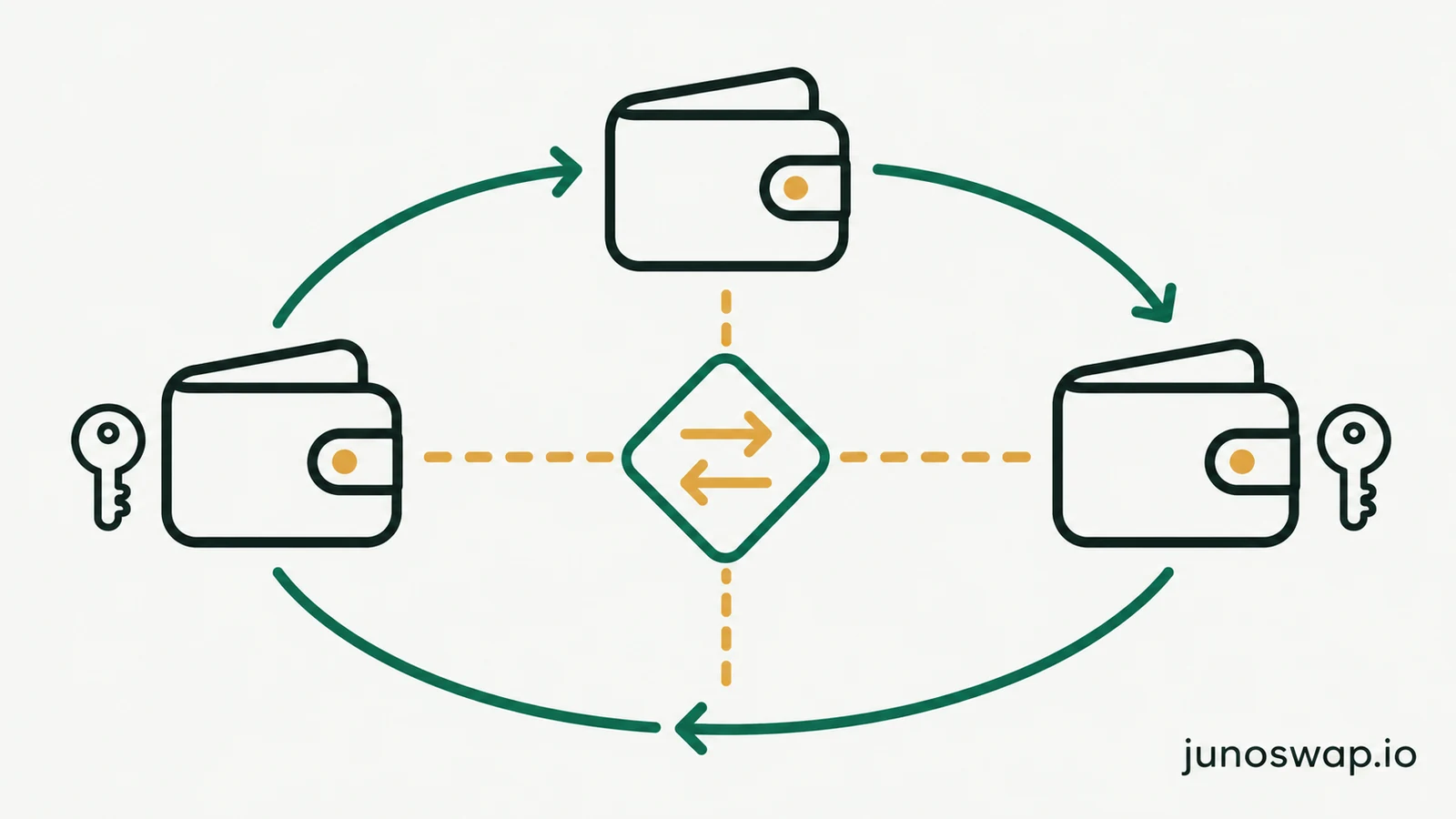
Self-custody means you control the keys or signing authority needed to move your assets, subject to the wallet's design. It does not mean every swap preserves that control throughout the transaction. Sending a deposit to a provider, granting a token approval or interacting with a bridge can introduce a new dependency.
The practical task is to draw a timeline: who can move the funds before the swap, during execution and after settlement? A personal wallet at both ends does not answer what happens in the middle. Understanding that middle stage is essential before comparing convenience or price.
A wallet is an interface to control
A crypto wallet manages information and signing operations associated with assets recorded on a network. The assets are not simply files stored inside the wallet application. Control depends on the relevant keys, permissions and network rules, not on the appearance of a balance screen alone.
A private key is secret material used to authorize actions. A recovery or seed phrase can restore access to a wallet's keys under its design. Anyone who obtains the necessary secrets may be able to control the associated assets. These are not ordinary account identifiers that support staff need to inspect.
A custodial account works differently: the provider controls the infrastructure or keys for the assets it holds, while the customer relies on the account and withdrawal process. A password for that account does not give the customer direct control of the provider's on-chain keys.
Multisig and other arrangements can distribute authority across more than one signer. In those cases, describe the actual signing threshold and participants rather than assuming a single person has complete control. The word “wallet” alone does not establish the arrangement.
Follow control through an instant swap
Before a deposit, a self-custody wallet's owner can decide whether to sign and broadcast the transfer. Once a transfer to a provider-controlled address is completed, the provider may control the deposited asset while processing the order. The customer then depends on the provider's execution and funds-access process.
After payout to a correctly controlled personal wallet, the customer may again have direct signing control over the output. That does not erase the intervening custody period. Settles to your own wallet and Provider holds funds during the swap can both accurately describe the same route at different times.
The deposit also creates an exposure to the provider's later-check and refund terms. If the order pauses for identity or source-of-funds review, possession of the destination wallet's keys does not authorize movement of funds still held by the provider.
Read the return route before entering this interval. Identify the returned asset, network, address requirements, potential deductions and any verification condition. A route that ends in self-custody still needs a clear answer for an order that never reaches the intended endpoint.
A DEX keeps you signing, but signatures have consequences
A DEX interaction can let a user trade from a personal wallet through smart contracts. The user may retain control of their keys, yet still authorize a contract to perform actions involving tokens. Key custody and token permissions are therefore separate questions.
Connecting a wallet, signing a message, approving token spending and submitting a swap are not identical actions. Read what the wallet says is being requested. If the interface does not make the action understandable, do not treat the prompt as a routine confirmation merely because previous prompts looked similar.
An approval can permit spending within its scope. Check the token, spender and amount where the wallet exposes those details. A broad permission can remain relevant after the immediate interaction, depending on the token and contract mechanism. The useful question is what authority persists, not simply whether the initial swap completed.
The Ethereum security guidance provides primary background on protecting wallet access and evaluating interactions. Its relevance does not turn every interface or contract into a vetted destination. Verify the actual application and transaction independently.
Contracts and bridges add different dependencies
A smart contract can execute a defined operation without a conventional support agent controlling each step. That automation does not establish that the code is free of defects or that the user has selected the intended contract. The interface and the contract need separate consideration.
A bridge moves value or representations between networks using a particular design. Depending on that design, the route may rely on additional validators, contracts, custodians or message-verification mechanisms. A cross-network transfer is not simply the same action with a different fee.
Wrapped assets also create an identification problem. A representation of an asset on one network may have different mechanisms and risks from the native asset. Confirm exactly what will arrive and whether the destination can use or accept it.
Do not compress these dependencies into a single “non-custodial” badge. A reader needs to know what authority they retain, what permissions they grant and what other system must function for the intended outcome to occur.
Protect recovery material before thinking about a swap
Keep recovery phrases and private keys out of websites, email, chat messages and support tickets. Juno Swap never asks for them. A request to reveal a recovery phrase to validate, synchronize or recover a transaction is not a normal editorial or exchange-support requirement.
Understand your wallet's documented backup and recovery process before relying on it. A backup that has not been understood can create a false sense of preparedness, while an exposed backup can undermine control of the wallet. Use the wallet's official documentation for its particular design.
Device security and physical access matter as well. Self-custody makes the user's operational choices part of the control model. It does not provide an account administrator who can simply reset a blockchain transfer after a mistake.
Avoid experimenting with recovery material in response to urgency. If an unsolicited contact claims immediate action is required, verify the situation through an independently established official route. Pressure is a reason to slow down the decision, not a substitute for evidence.
Verify the destination and the asset representation
Check the asset, network and receiving address together. A correct-looking address on the wrong network can still fail to produce the intended result. A personal wallet's ability to display a network does not establish that a custodial recipient accepts deposits there.
Inspect the final signing screen where the wallet provides transaction details. Compare the destination with the intended address and review the asset and amount. Saved addresses and copied text still need checking; familiarity is not proof that the current transfer is correct.
If a memo or tag is required by the recipient, include it exactly as instructed. Do not assume a personal wallet's previous successful transfer establishes the instructions for a new recipient. Deposit requirements belong to the actual destination.
Keep enough of the appropriate native asset or resources to perform required network actions where applicable. A token balance alone may not fund transaction execution. Read the wallet's current fee information and distinguish those network costs from the swap provider's charges.
A hypothetical wallet-to-wallet route
Imagine a user starts with an asset in a personal wallet, sends it to an instant exchange and expects a different asset in another personal wallet. Before broadcast, the user controls the input. During provider processing, the user does not control the provider's deposit keys. After a successful payout, the user controls the output destination.
Calling the entire route “self-custody” hides the period most relevant to a verification hold or refund dispute. The more accurate description identifies the custody transition and its conditions. That description helps the user decide whether the trade fits their requirements before sending.
Now compare a DEX route that requires a token approval and a swap transaction. The user keeps the wallet keys, but the approval grants a defined permission. The risk question shifts toward the authorized spender, contract behavior and execution conditions.
Neither route can be assessed from the wallet logo or the final destination alone. The meaningful comparison is a sequence of permissions and transfers, with a clear account of what happens if the sequence stops midway.
After the swap, verify settlement rather than the animation
Check that the intended asset arrived on the intended network and is recognized by the receiving wallet or account. An interface message saying “complete” should be understood in terms of the stage it describes. The provider's completion status and the recipient's usable balance are related but distinct observations.
Review any permissions created during the route where the wallet and network support that inspection. Determine whether ongoing permissions remain appropriate. Do not sign an unfamiliar “revoke” transaction from an unsolicited link; the tool used to manage permissions also needs verification.
Keep a private record of the transaction for your own accounting and any applicable obligations. Self-custody does not remove tax, reporting or eligibility requirements. This publication provides general information, not advice tailored to those duties.
If the result is unexpected, stop further transfers and identify the stage, network and asset involved. Use the official support or documentation for the relevant component. A problem at the receiving account, provider or contract may require a different response from a wallet-display issue.
What self-custody does not promise
Control of keys does not guarantee privacy. Public networks can expose transaction activity, and services or counterparties can retain information they receive. A wallet without an identity form does not make every connected action anonymous.
Control also does not guarantee liquidity, a particular rate or successful execution. A contract interaction can fail, a network can become expensive to use and a provider can impose documented conditions on a route involving its custody. Keep these risks separate rather than treating the wallet model as an all-purpose answer.
Finally, self-custody does not establish that every displayed asset is authentic or intended. Verify the network-specific representation through authoritative information and the recipient's requirements. A familiar name or symbol can be copied more easily than the underlying mechanism can be understood.
The Juno Swap methodology evaluates custody transparency without presenting a score as a probability of protection. Read the service-type comparison for alternative mechanisms and network selection for the checks that precede any transfer.
Questions readers ask
Does keeping my seed phrase mean a swap never holds my funds?
No. If you transfer assets to a provider-controlled address, the provider can hold those assets during the order even though you retain the keys to your own wallet. Follow the custody timeline.
Is connecting a wallet the same as approving token spending?
No. Connection, message signing, token approval and transaction submission are different actions. Read the actual request and its scope instead of treating every wallet prompt as equivalent.
Can Juno Swap check or restore my recovery phrase?
No. Juno Swap never asks for seed phrases or private keys and does not provide wallet recovery. Do not send those secrets to the publication or to an unsolicited person claiming to represent it.
Does self-custody remove network, contract or legal risks?
No. It describes control, not every condition affecting a transaction. Network compatibility, permissions, contract behavior, provider terms and applicable obligations still need separate consideration.