Instant exchange, DEX or P2P: how the mechanism changes control of your funds
Follow custody, execution and dispute handling through three exchange models before comparing their quotes or verification labels.
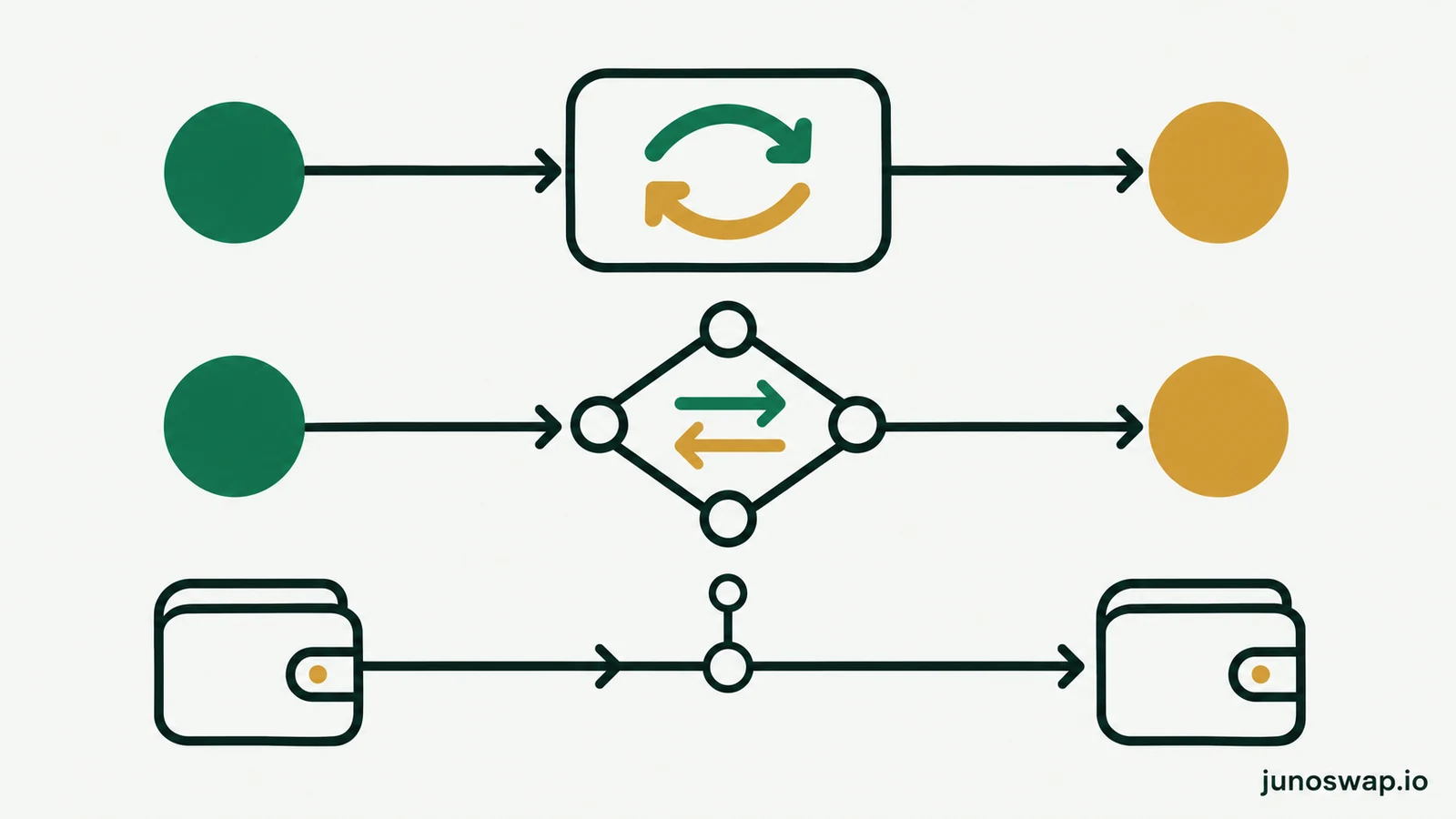
An instant exchange generally takes an order to convert one asset into another; a DEX uses on-chain trading mechanisms; a P2P platform connects counterparties who trade under a defined process. The decisive comparison is who controls the funds at each stage and who can resolve a failed transaction.
Those categories are starting points, not guarantees. An aggregator can route an order to another executor. A DEX interface can introduce separate permissions and infrastructure. A P2P trade can involve escrow and a payment method with its own dispute rules. Follow the actual route rather than assigning every service the properties of its category name.
An instant exchange is an order-based route
In a typical instant-swap flow, the customer selects an asset pair and amount, receives deposit instructions and supplies an output destination. The provider processes the exchange after the relevant conditions are met. The word “instant” describes a product category, not a universal completion-time promise.
If the deposit goes to an address controlled by the provider, the provider holds the funds during that part of the route. A final payout to your own wallet does not remove that interval. Record temporary provider custody separately from the destination of the output.
The order can also depend on a rate mode, deadline, minimum amount, network and confirmation requirement. A quote that looks simple on screen may therefore represent several conditions. Read what happens if the deposit is late, incorrect or subject to verification before assuming the displayed output remains available.
For a failed order, the provider's refusal and refund terms matter. Ask who authorizes a return, which asset and network it uses, what deductions apply and whether identity checks remain necessary. The service type alone does not answer these questions.
An aggregator adds a routing layer
A swap aggregator compares or routes transactions through other sources of execution or liquidity. The interface that displays the quote may not be the party that receives the deposit. Identify the executor and determine which terms apply to its part of the transaction.
This distinction affects support. A customer may need to establish whether the aggregator handles the order record, the executor handles settlement, or both have roles. A statement about the aggregator's own data collection does not automatically describe the executing partner's checks.
It also affects cost. The route can include charges or rate differences at more than one layer. Compare the net amount delivered and make clear whether the displayed quote includes downstream deductions. Do not assume that an aggregator's largest headline output is a final payout.
For a reader, the useful question is not whether an aggregator is inherently better or worse. It is whether the extra layer makes the route more understandable and suitable for the intended transaction. If the executor or applicable policy is unclear, preserve that uncertainty.
A DEX changes the execution mechanism
A decentralized exchange commonly executes trades through smart contracts and on-chain liquidity arrangements. The customer may sign transactions from a self-custody wallet rather than deposit into a conventional exchange account. That changes the control model, but it does not eliminate execution risk.
Distinguish connecting a wallet from authorizing an action. A connection can expose account information to an interface; a signature or transaction can authorize a specific operation. Token approvals may grant a contract permission to spend tokens within the approval's scope. Read the actual request rather than treating every prompt as a harmless login.
Smart contracts, interfaces and networks are separate components. A contract can have a defect, an interface can direct the user toward an unintended action, and network conditions can prevent execution on the expected terms. An audit, where one exists, has a scope and date; it is not a promise about every future interaction.
Some routes cross networks through bridges. That introduces additional mechanisms and assumptions beyond a same-network swap. The Ethereum documentation on bridges describes different designs and their risks. A bridge should be evaluated as part of the route, not hidden under a single DEX label.
P2P adds a counterparty and a settlement decision
A P2P platform helps buyers and sellers arrange a trade. Depending on the model, crypto may be held in escrow while another payment leg takes place. The platform's process determines how release, cancellation and disputes are handled.
Escrow is a control arrangement, not a guarantee that every disagreement will end in your favor. Identify who can release the asset, what evidence the process accepts and whether a third party can intervene. Multisig arrangements can distribute signing authority, but the exact signing rules still matter.
The payment leg deserves separate attention. A notice that money was sent is not always the same as confirmed receipt in the relevant account. The payment method's reversal and dispute properties can affect the trade. Do not release escrow solely because a counterparty supplies an image or asks to move the discussion elsewhere.
Verification can exist at several levels: the platform, the counterparty or the payment provider. A P2P label does not establish that the entire route lacks identity requirements. Eligibility and applicable rules remain separate checks.
Custodial accounts are another distinct model
A custodial exchange account generally represents assets held under the platform's control rather than direct control of private keys by the customer. Trading inside the account and withdrawing on-chain are different operations. An internal balance change is not itself evidence that the customer can withdraw at that moment.
Read withdrawal conditions, verification requirements and supported networks alongside trading terms. A service may offer a convenient trading interface while imposing separate conditions on deposits or withdrawals. Avoid using a trading fee as a proxy for the cost and feasibility of the entire route.
Persistent custody also changes the time boundary. In an order-based swap, the intended provider-custody period may end at payout. In an account model, funds can remain with the provider until a later withdrawal. The reader needs to choose how much continuing dependence on that provider they are willing to accept.
This is why Juno Swap distinguishes Custodial account, Provider holds funds during the swap and Settles to your own wallet. These descriptions can apply to different stages and should not be compressed into one reassuring icon.
Compare the same five questions across models
First, identify who can authorize movement of the asset before, during and after the transaction. For an instant exchange, that may include a provider-controlled deposit. For a DEX, inspect the contract interaction and any approval. For P2P, inspect escrow and release authority.
Second, locate verification requirements and their timing. Check the operator, executor, counterparty and payment leg where relevant. Do not infer the absence of later checks from the absence of an initial upload field.
Third, compare final cost under a consistent boundary. Include separately paid network actions and distinguish a final output from an estimate. For P2P, account for the actual payment route rather than comparing only the quoted exchange rate.
Fourth, examine failure handling. Who can respond if a deposit is uncredited, a transaction reverts, a counterparty disputes payment or a provider requests documents? A process with no documented resolution route should be described as uncertain, not silently assigned the most favorable outcome.
Fifth, confirm eligibility and compatibility. The asset, network, payment method and jurisdiction must fit the intended use. A service being technically accessible does not establish that it may be used by every visitor.
A hypothetical choice between three routes
Suppose a reader wants to exchange one supported asset for another and receive it in a personal wallet. An instant exchange offers a deposit-and-payout process. A DEX route requires a wallet signature and network fees. A P2P listing involves a counterparty and an escrow release process.
The instant exchange may be easier to describe operationally, but the reader must accept its custody interval and later-check terms. The DEX route may keep the user in a signing role, but the reader must understand approvals, minimum output and contract execution. The P2P route requires confidence in the documented payment and dispute process.
No category wins from those descriptions alone. A reader who cannot use the required network, satisfy the relevant conditions or understand the release step does not have a suitable route simply because its displayed price is lower.
Now imagine the DEX path requires a bridge to reach the destination. That is a materially different route from a same-network swap. Add the bridge's mechanics, time and risk to the comparison rather than preserving the original simple label.
A useful personal comparison can describe each candidate in one complete sentence: I authorize this transfer, this party or contract controls this stage, and this documented process determines release. If the sentence cannot be completed without guessing, identify the missing fact before proceeding. This exercise does not require technical expertise in every network. It requires recognizing where an interface has left the reader dependent on information that has not yet been established.
What evidence can and cannot establish
Reading a policy establishes what the policy states on a date. Inspecting an interface establishes what was visible in that inspection. Sampling a quote establishes an observed quote with its parameters. A completed funded trade establishes the outcome of that recorded trade.
None of these automatically proves every other stage. A funded swap does not demonstrate a refusal refund, and a refund test does not establish how every future dispute will be handled. Evidence becomes more useful when its boundary is explicit.
Juno Swap's methodology keeps evidence stages, policy class, risk state and editorial score separate. Use that structure when comparing categories. It lets a reader see both what has been documented and what remains untested without interpreting an incomplete record as either an endorsement or an accusation.
Continue with self-custody and swap risk to follow control through a transaction, and comparing swap costs to put different route estimates on a consistent basis.
Questions readers ask
Does a wallet-to-wallet payout make a swap non-custodial?
Not necessarily. A provider may control the deposited asset during the exchange even when the output goes to a personal wallet. Describe each stage rather than inferring the entire custody model from the final destination.
Does a DEX remove every identity or eligibility question?
No. The interface, connected services and other route participants can have conditions of their own. Technical access does not establish legal eligibility. Read the applicable terms and understand the actual transaction path.
Does escrow guarantee a successful P2P trade?
No. Escrow defines how an asset is held and released. The release rules, dispute evidence, counterparty behavior and payment mechanism still matter. Identify those conditions before committing funds or releasing an asset.
Is an aggregator the same as the executing exchange?
Not always. It can display or route an order while another party performs the exchange. Identify the executor, its applicable policy and the support responsibilities for the selected route.